In the world of AI, we have a size problem. Everyone is obsessed with “bigger.” More parameters, more data, billion-dollar supercomputers. The industry logic has been simple: if you want a smarter brain, you have to build a bigger brain.
But Samsung just dropped a research paper that flips the table on that entire idea.
They built a model called TRM (Tiny Recursive Model). It has only 7 million parameters. For context, modern “giant” models like GPT-4 or Gemini have trillions of parameters. TRM is roughly 100,000 times smaller. It’s the size of a rounding error.
Yet, on complex logic puzzles where giant models often fail, this tiny model didn’t just compete—it crushed them.
Here is the breakdown of the paper “Less is More,” and why it might be the most important AI signal of the year.
The Secret Sauce: “Think Again”
How does a 7-million parameter model beat a trillion-parameter giant? It cheats. (Well, sort of).
Most large language models (LLMs) work like an improvisational actor. They see a question and immediately start talking. They generate one word after another, never looking back. If they make a mistake in the first sentence, they are stuck with it. They possess “System 1” thinking: fast, intuitive, and reactionary.
TRM works like a student taking a math test.
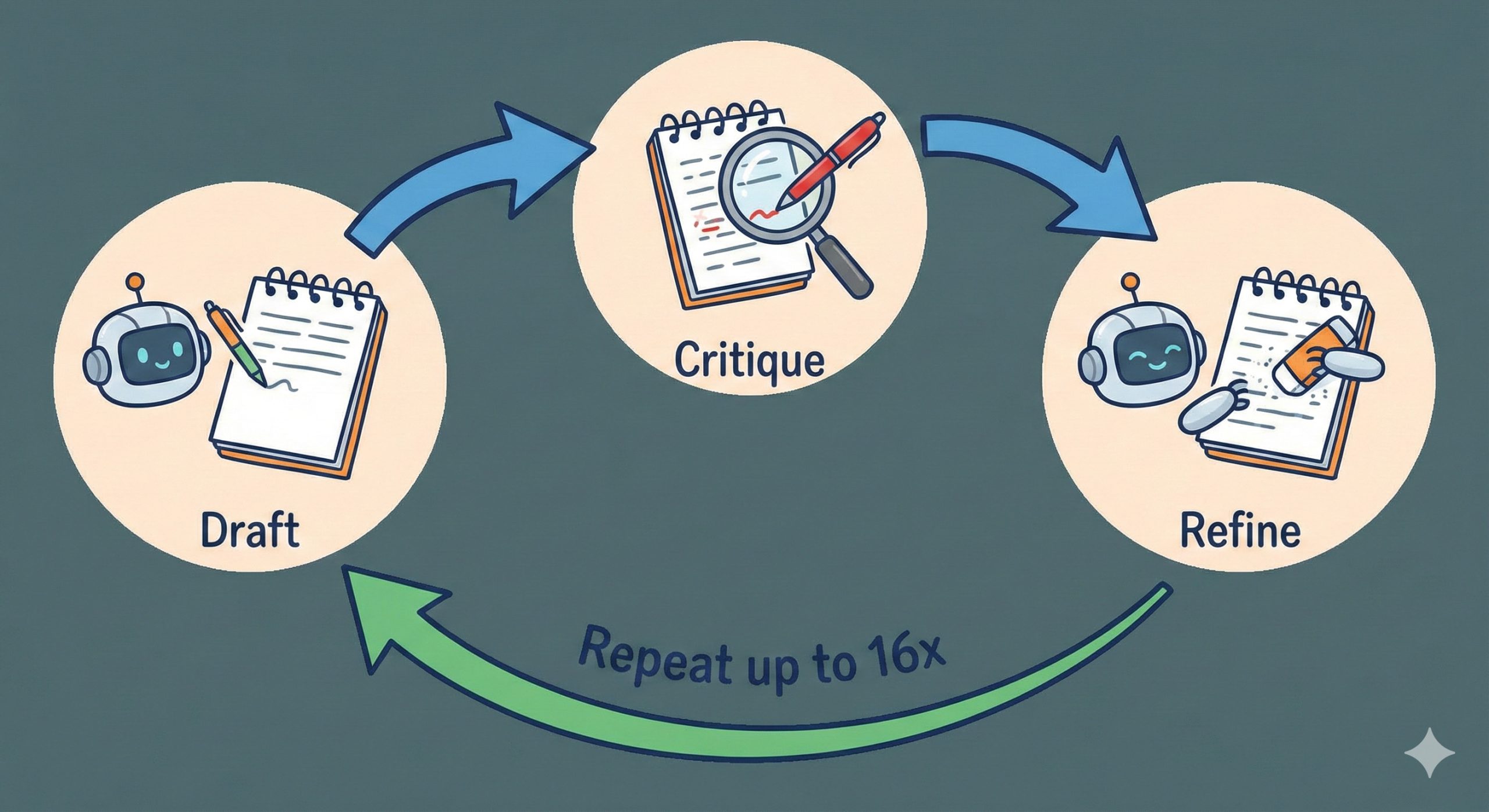
Instead of blurting out an answer, TRM uses a Recursive Loop. It forces itself to pause and refine its answer up to 16 times before showing it to you.
The “Draft & Polish” Loop
Imagine asking an AI to write an essay.
-
Standard AI: Writes the essay from start to finish in one go. If it drifts off-topic in paragraph 2, the essay is ruined.
-
Samsung’s TRM:
-
Writes a rough draft.
-
Reads the draft and thinks, “This part looks wrong.”
-
Updates its internal “thought” (latent state).
-
Rewrites the draft based on the new thought.
-
Repeats this 16 times.
-
By the time TRM gives you the final answer, it hasn’t just “guessed” it; it has critiqued and fixed its own work 16 times.
The Scoreboard
The researchers tested TRM on tasks that require pure logic—where you can’t just “fake it” with good grammar. The results were startling.
1. Sudoku
Sudoku is a nightmare for standard AI because one wrong number ruins the whole grid.
-
The Giants (LLMs): Often struggle or fail completely (0% to 50% accuracy on extreme levels).
- Samsung TRM: 87.4% Accuracy.
It reasoned its way through the grid, fixing conflicts in its “mind” before filling the cells.
2. Mazes
-
The Giants: often get lost in long paths.
- Samsung TRM: 85.3% Accuracy.
It could “look ahead” and backtrack mentally to find the exit.
3. ARC-AGI
ARC-AGI is a famous benchmark designed to be easy for humans but impossible for AI. It requires learning new rules on the fly from just a few examples.
-
The Result: TRM scored 44.6% on ARC-AGI-1. This punches way above its weight class, outperforming models that are thousands of times more expensive to run.
Why This Matters
You might be thinking, “Great, it’s good at Sudoku. So what?”
The implications go far beyond puzzles.
1. AI on Your Toaster
Right now, if you want smart AI, you need an internet connection to send your data to a massive server farm. TRM is so small (7M parameters) that it could run on a smartwatch, a thermostat, or even a budget smartphone—offline. This brings “reasoning” to the edge, protecting your privacy and battery life.
2. The End of “Brute Force”
We are running out of data to train giant models, and we are running out of electricity to power them. TRM proves that architecture > scale. We don’t necessarily need bigger chips; we need smarter algorithms.
3. Quality over Quantity
This paper validates a shift in AI toward “Inference-Time Compute.” This means giving the AI time to “think” while you wait, rather than just training a bigger model beforehand. It turns out, waiting 2 seconds for a smart answer is better than getting a dumb answer instantly.
The Takeaway
The industry has been building Ferraris to drive to the grocery store. Samsung just showed up with a bicycle that takes a shortcut through the alley and gets there faster.
TRM isn’t going to replace ChatGPT for writing poems or coding website apps just yet, it’s specialized for reasoning. But it proves a massive point: Intelligence isn’t just about how much you know; it’s about how well you think.