Ever OCR a document, chunk it for RAG, and wonder why the answers are completely off?
You followed the standard playbook: OCR, embed, retrieve. Tutorials make it look simple. But the results keep missing the point.
The problem is that real documents are not just text. They are layouts. Tables, headers, stamps, handwritten notes squeezed into margins. OCR flattens all of that into a plain string, and RAG retrieves it without any awareness of where things were or how they related to each other. You get fragments that sound plausible but miss the actual meaning.
There is a better approach: visual-first models.
Models like ColPali and ColQwen2 skip the text extraction step entirely. They embed full document page images directly, preserving layout, spatial structure, and visual context inside the vector space. Retrieval becomes much more grounded because the model actually “sees” the page the way a human would.
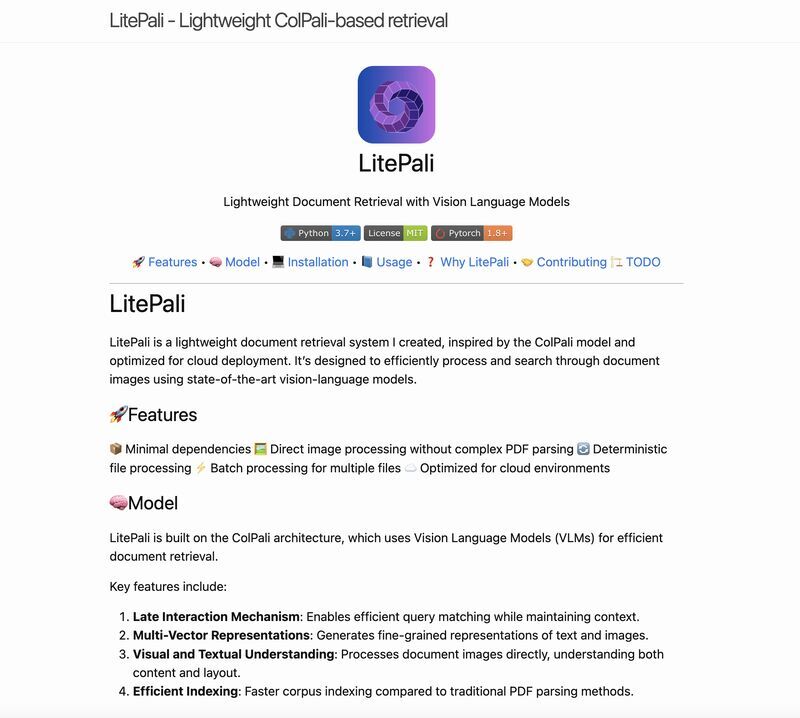
If you want something practical to try today, LitePali is worth a look:
– Based on ColPali, so the foundation is solid
– Retrieves directly from images, no PDF parsing required
– Uses late-interaction for precise query-to-document alignment
– Compact memory footprint, easy to run without heavy infrastructure
– Python-native, straightforward to deploy
No chunking pipelines. No fragile prompt engineering around extracted text. Just document semantics, searchable and structurally intact.
If OCR plus RAG keeps producing garbage, the architecture might be the bottleneck, not your prompts. Thinking in layouts rather than tokens is often the fix.